
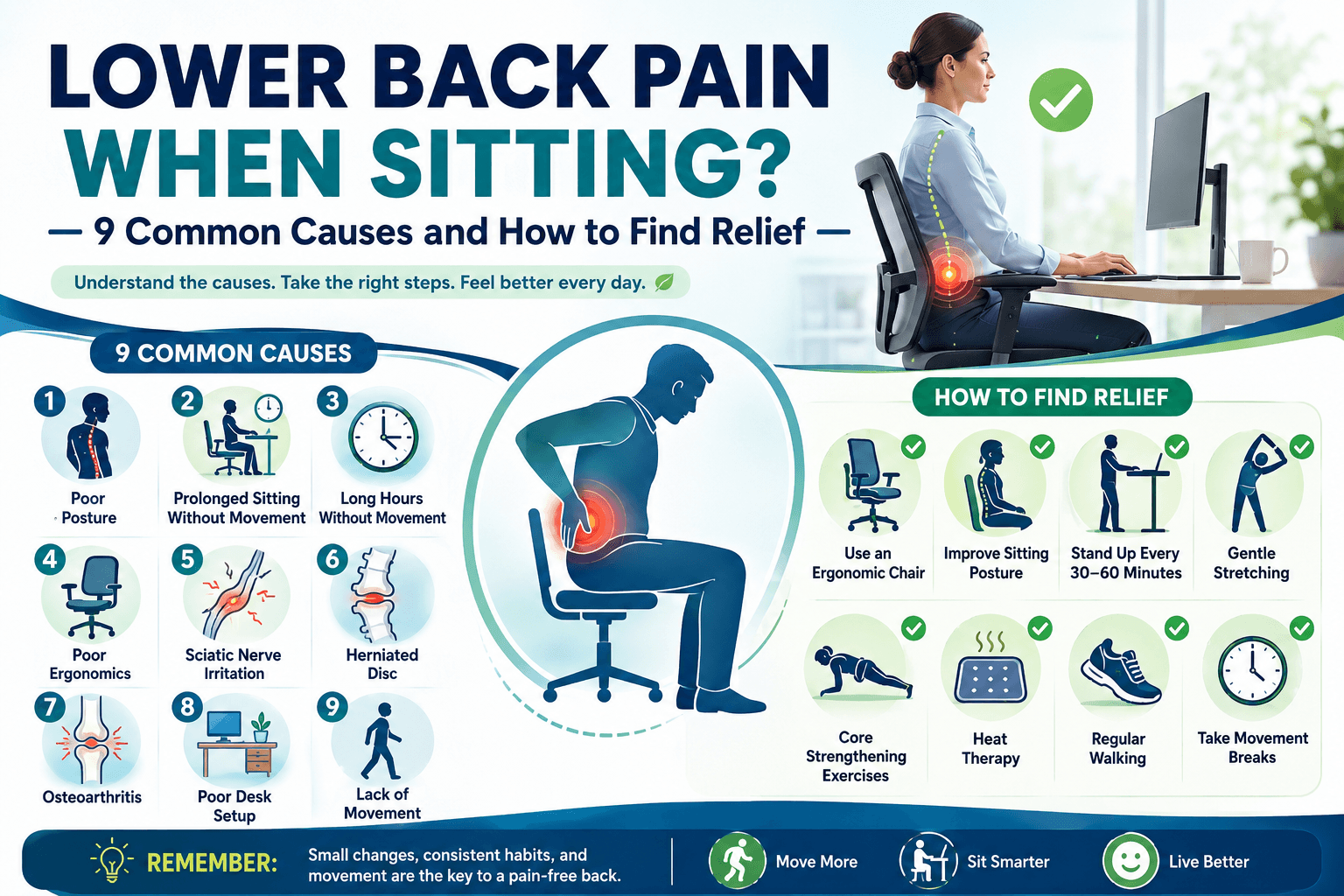
Lower Back Pain When Sitting? 9 Common Causes and How to Find Relief
DisclaimerThis article is for general educational purposes and is not a substitute for professional medical advice, diagnosis, or treatment. Always consult a qualified healthcare provider for guidance specific to your condition.
Is your chair sabotaging your spine? Discover the hidden reasons sitting hurts your lower back and how to finally find relief.
Understanding Lower Back Pain When Sitting
Let’s be real, lower back pain while sitting can feel utterly devastating. If you’ve ever shifted restlessly at your desk or dreaded a long car ride, you’re not alone. In fact, up to 80% of adults will experience low back pain at some point, and for a shocking number of us, sitting is the trigger that makes things go from annoying to downright agonizing.
But what’s really going on when our backs start screaming for mercy? And more importantly, what can we do to break free from this relentless cycle?
First things first: sitting is surprisingly tough on your spine. When you plop down, your lumbar spine (that’s the lower part) is put under 40% more pressure than when you’re standing. That’s a jaw-dropping stat, especially for anyone chained to a desk for 6 to 8 hours a day. But don’t panic, you’re not doomed to a lifetime of discomfort. The trick is to uncover what’s fueling the pain and tackle those triggers head-on.
9 Common Causes of Lower Back Pain When Sitting
Ready to uncover the real-life villains behind your back pain? Let’s dive into the most common reasons with relatable examples and practical explanations.
1. Poor Posture
Slouching, hunching over your laptop, or perching precariously on the edge of your chair sound familiar? Poor posture is the undisputed arch-nemesis of healthy backs. When you slouch, the natural curve of your lower spine flattens, ramping up the strain on your muscles and discs.
Quick Fact: A 2018 study found that people slouching for over 30 minutes had a 35% rise in lower back muscle fatigue compared to those who sat upright. Yikes!
Spot the Signs:
- Rounded shoulders
- Head jutting forward
- Pelvis rolled backward
Why Does It Hurt So Much? Your body’s center of gravity shifts forward, forcing your back muscles into overdrive. Over time, this can spiral into chronic pain or even herniated discs, a nightmare scenario nobody wants.
2. Prolonged Sitting
Even with perfect posture, simply sitting for too long is a recipe for trouble. The average office worker is glued to their chair for a staggering 6.5 hours daily, cutting off blood flow to back muscles and squishing spinal discs.
Table: Sitting Time and Back Pain Risk
| Sitting Duration (per day) | Increased Risk of Back Pain |
|---|---|
| < 4 hours | Low (10%) |
| 4–6 hours | Moderate (28%) |
| > 6 hours | High (46%) |
Staying put for hours makes muscles and ligaments stiff and less flexible, creating the perfect storm for back pain to invade your life.
3. Weak Core Muscles
Surprise your core has a secret superpower when it comes to back health! And it’s not just about six-pack abs. Your core includes deep stabilizing muscles that wrap around your spine and pelvis like a natural brace.
Did You Know? In a sample of 120 adults battling chronic low back pain, 68% had below-average core strength scores.
How Does This Happen? If your core isn’t up to the challenge, your back is forced to absorb extra pressure every time you sit, making it vulnerable to exhaustion and strain.
4. Herniated or Bulging Discs
This is the stuff of nightmares for anyone who’s felt a sudden, sharp pain shoot down their leg. A herniated (or slipped) disc happens when the jelly-like center of a spinal disc breaks through its tough exterior, irritating nearby nerves. Sitting makes this worse by cranking up the pressure.
Scary Stat: About 5–20 per 1,000 adults experience a herniated lumbar disc every year.
Spot the Symptoms:
- Sharp, shooting pain down your leg (sciatica)
- Numbness or tingling
- Pain that explodes when you sit or bend
5. Degenerative Disc Disease
As we rack up birthdays (or just get a little unlucky), the discs between our spinal bones can wither away, a condition called degenerative disc disease. By age 50, MRI scans reveal that a staggering 85% of people have some disc degeneration, though not everyone feels the pain.
Why Sitting Stings: Worn-out discs can’t cushion your spine effectively. When you sit, the added pressure on these “thin” discs can spark relentless discomfort, especially after long stints at your desk.
6. Muscle Strain or Sprain
Sometimes, all it takes is a simple twist to grab your phone, and boom, you’ve strained your back. Inflamed muscles get angry fast, and sitting (especially on a rigid chair) can make that pain feel unbearable.
Common Triggers:
- Sudden, awkward movements
- Lifting heavy stuff incorrectly
- Sports mishaps
How Long Does It Last? Most strains heal within 7–21 days, but if you don’t fix the underlying habits, that pain can stick around like a bad guest.
7. Sciatica
Sciatica isn’t a diagnosis, it’s a warning sign. Usually caused by squished nerves, the sciatic nerve runs from your lower back, through your hips and butt, and all the way down each leg. Sitting on a hard chair can turn a dull ache into a blazing fire.
Prevalence: Up to 40% of adults experience sciatica at some point.
Classic Clues:
- Burning, tingling, or shooting pain down your leg
- Numbness or weakness
- Pain gets worse the longer you sit
8. Sacroiliac Joint Dysfunction
Your sacroiliac (SI) joints link your spine to your pelvis. When these joints get inflamed thanks to injury, arthritis, or even pregnancy, it can mimic classic lower back pain, especially when you’re sitting.
Table: SI Joint Dysfunction vs. Other Lower Back Pain
| Symptom | SI Joint Dysfunction | Typical Lower Back Pain |
|---|---|---|
| Pain Location | Just above buttocks | Center/side of lower back |
| Worsens When | Sitting, standing up | Bending, lifting |
| Radiation | Groin, thigh | May reach the leg |
9. Underlying Medical Conditions
Sometimes, lower back pain is a red flag, a sign that something more sinister is lurking. Spinal stenosis, arthritis, infections, or tumors (though rare) can all be culprits.
Watch For:
- Spinal stenosis: Narrowing of the spinal canal, affecting up to 8% of adults over 50
- Osteoarthritis: Wearing down of joint cartilage, leading to relentless stiffness and pain
Don’t Ignore These Red Flags:
- Unexplained weight loss
- Fever
- Loss of bladder or bowel control
If you notice any of these, see a doctor ASAP.
How to Find Relief: Practical Steps and Solutions
Here’s the good news: you’re not powerless. Let’s arm you with a battle plan to beat lower back pain from sitting, tailored to each of the culprits above.
Step 1: Optimize Your Sitting Posture
- Plant both feet flat on the ground (or use a footrest).
- Adjust your chair so your hips and knees are at 90-degree angles.
- Supporting your lower back with lumbar pillows is a lifesaver.
- Resist the urge to cross your legs for long stretches.
Pro Tip: Set a timer to check your posture every 30 minutes. It sounds simple, but it’s a game-changer!
Step 2: Limit Prolonged Sitting
- Stand up or take a brisk walk every 30–60 minutes, even just for 2–5 minutes.
- Try a sit-stand desk. Some studies show a 32% drop in back discomfort after making the switch.
Step 3: Strengthen Your Core
Your core is your body’s built-in armor. Strengthening it can transform your back health.
- Planks (hold for 20–30 seconds, repeat 3–5 times)
- Bird-dog (10 reps per side)
- Pelvic tilts (15 reps)
How Often? Aim for at least 3 times a week most people see real changes within 6 weeks.
Step 4: Address Herniated or Bulging Discs
- See a healthcare provider for an accurate diagnosis (an MRI might be in order).
- Physical therapy (PT) is a powerhouse 75% of people get relief within 3 months.
- Anti-inflammatory medications can help tame the pain.
Step 5: Manage Degenerative Disc Disease
- Move and stretch regularly to keep joints loose and happy.
- Use heat or ice for flare-ups.
- Go for low-impact activities (think swimming or cycling) these can slash spinal pressure by 50% compared to running or contact sports.
Step 6: Treat Muscle Strains and Sprains
- Rest at first, but don’t stay in bed too much downtime can make pain worse.
- Ice for the first 48 hours, then switch to heat.
- Gentle stretching and a slow return to activity are crucial over 90% of strains heal without surgery.
Step 7: Relieve Sciatica
- Ditch hard chairs; use a cushion for support.
- Try gentle hamstring and piriformis stretches to ease nerve pressure.
- For stubborn pain, PT or medication may be needed 60% of sciatica cases improve within 6 weeks using conservative care.
Step 8: Address SI Joint Dysfunction
- SI joint belts or braces offer extra support.
- Strengthen pelvic and hip muscles with gentle exercises.
- If pain won’t quit, ask your doctor about injections or manual therapy.
Step 9: Rule Out Serious Medical Conditions
- See your doctor if pain is severe, lingers past 6 weeks, or comes with red-flag symptoms.
- Imaging tests or blood work might be needed to uncover hidden problems.
Table: At-a-Glance Relief Strategies
| Cause | Primary Relief Methods | Time to Improvement |
|---|---|---|
| Poor Posture | Ergonomic adjustments, posture reminders | 1–2 weeks |
| Prolonged Sitting | Frequent breaks, sit-stand desk | 1–2 weeks |
| Weak Core | Core strengthening exercises | 4–6 weeks |
| Herniated/Bulging Disc | PT, medication, ergonomic changes | 1–3 months |
| Degenerative Disc Disease | Low-impact activity, heat/ice | Ongoing |
| Muscle Strain/Sprain | Rest, ice/heat, gradual stretching | 1–3 weeks |
| Sciatica | Cushion, stretching, PT | 2–6 weeks |
| SI Joint Dysfunction | Belt, PT, injections | 2–8 weeks |
| Medical Conditions | Medical evaluation, targeted treatment | Varies |
When to Seek Professional Help
Most back pain fades with smart self-care and a little patience. But if your pain is intense, lingers past 6 weeks, or comes with numbness, weakness, or loss of bladder/bowel control, don’t tough it out get help immediately. Your health is too precious to gamble with.
Final Thoughts on Taking Action
Here’s the bottom line: pinpointing the real cause of your lower back pain is the first step toward victory. By understanding these common triggers and making a few targeted changes (sometimes as simple as standing up more often!), you can conquer your discomfort and reclaim your life.
Remember, you’re not alone in this fight, and with the right strategies, relief is absolutely within your reach.
Here’s to standing tall, sitting strong, and living pain-free!
Need more tips or want to share your story? Drop a comment below we’re in this together!
Conclusion:
Understanding the root causes of lower back pain when sitting empowers you to take focused, practical steps toward relief. From correcting posture and strengthening your core to taking regular breaks and seeking professional help when needed, small changes can have a big impact on your comfort and spinal health. Listen to your body, make gradual improvements, and remember consistent action is key to lasting relief.
FAQ:
-
How can I tell if my lower back pain from sitting is serious?
If your pain is severe, lasts more than 6 weeks, or is accompanied by symptoms like numbness, weakness, or loss of bladder/bowel control, consult a healthcare provider promptly. -
What are some quick ways to relieve lower back pain while sitting at work?
Adjust your chair for lumbar support, sit with feet flat on the ground, take standing or walking breaks every 30–60 minutes, and use a cushion if needed. -
Can exercises really help reduce sitting-related back pain?
Yes, regular core-strengthening exercises and gentle stretching can improve spinal stability and reduce discomfort, often leading to noticeable results within a few weeks.
Stay updated
Get new health articles on WhatsApp
By subscribing, you agree to receive health updates via WhatsApp. Unsubscribe anytime.