
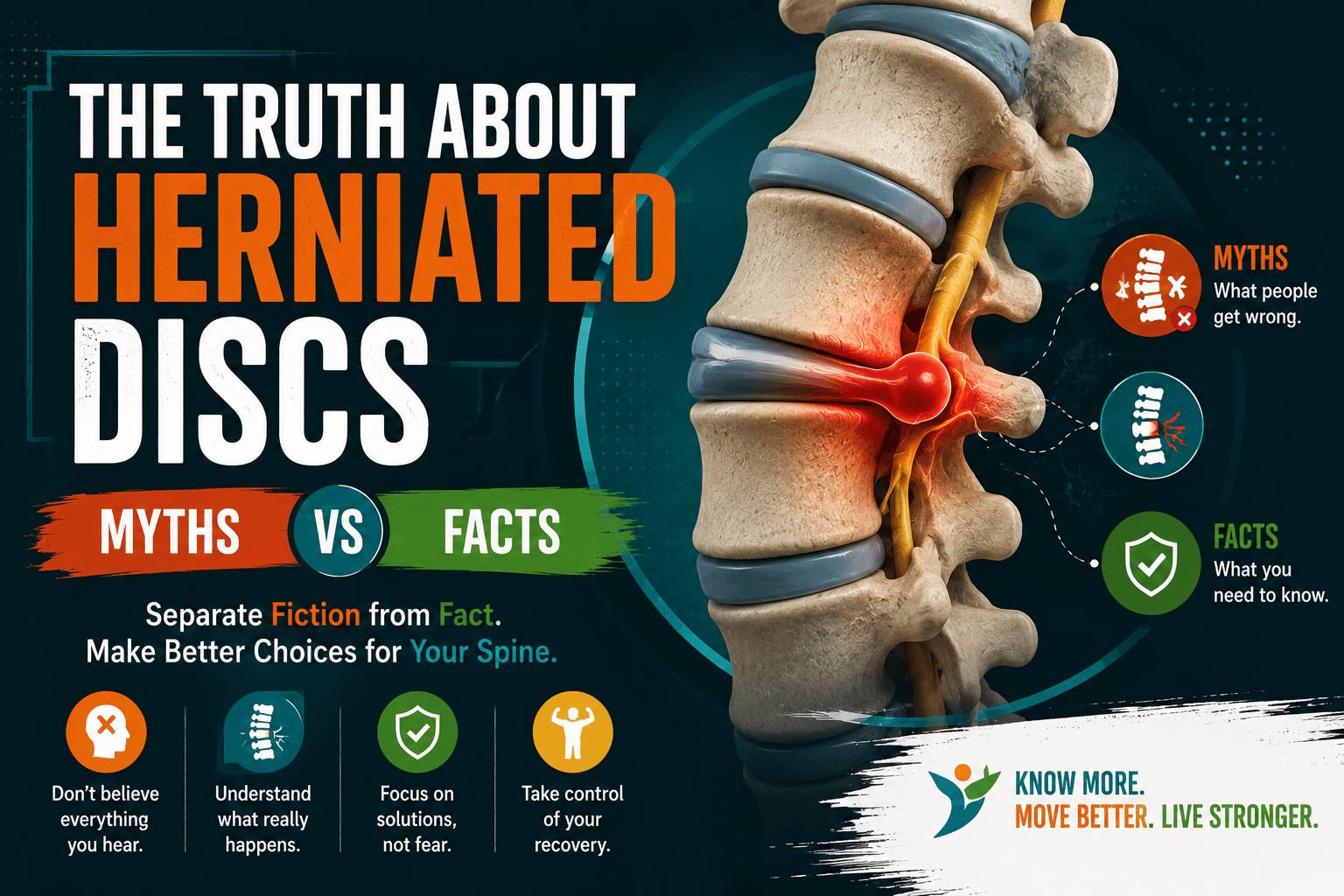
The Truth About Herniated Discs (Myths vs Facts)
DisclaimerThis article is for general educational purposes and is not a substitute for professional medical advice, diagnosis, or treatment. Always consult a qualified healthcare provider for guidance specific to your condition.
Think herniated discs are a life sentence, only for seniors, or always require surgery? Get ready to rethink everything you thought you knew about back pain.
The Truth About Herniated Discs: Myths vs. Facts
Introduction: Smashing the Myths About Herniated Discs
Let’s be honest, when it comes to herniated discs, the avalanche of misinformation out there can feel overwhelming, if not downright terrifying. Maybe you’ve heard a horror story from a friend, or perhaps you read something online that left you worried about your own back health. Here’s the reality: millions of people struggle with back pain every year (the CDC estimates nearly 5% of adults!), but most of what we hear about herniated discs is jaw-droppingly inaccurate.
So, let’s roll up our sleeves, bust some persistent myths, and unravel the truth about herniated discs—what causes them, how they really feel, and what you can do about them.
Myth 1: Herniated Discs Only Affect Older Adults
Fact: Herniated Discs Can Strike at Any Age
Think herniated discs are only something your grandparents need to worry about? Think again. While age does increase your risk—thanks to wear-and-tear and degenerative disc disease—it’s far from the whole story. In fact, some shocking sports medicine studies reveal that up to 30% of college athletes have experienced disc-related back pain before the age of 25!
Table 1: Age Distribution of Herniated Disc Cases
| Age Group | % of Cases | Common Causes |
|---|---|---|
| Under 30 | 22% | Sports injuries, trauma |
| 30-50 | 58% | Degeneration, lifestyle |
| Over 50 | 20% | Age-related degeneration |
It turns out, genetics, repetitive strain, and even a single unlucky twist can trigger a herniated disc in your 20s. So, no matter your age, it pays to be spine-savvy!
Myth 2: Herniated Discs Always Cause Agonizing Pain
Fact: Symptoms Can Range from Mild to Nonexistent
Here’s a common nightmare: you hear “herniated disc” and instantly picture yourself doubled over in agony. But reality? Up to 40% of people with MRI-confirmed herniated discs don’t feel a thing! Why? Not all disc herniations press on nerves or cause the kind of inflammation that leads to pain.
How Do Symptoms Actually Show Up?
- Disc Herniation Occurs: The soft center (nucleus pulposus) pushes out through the outer layer (annulus fibrosus).
- Nerve Gets Involved: If it touches a nerve root, symptoms can escalate—think tingling, numbness, or weakness.
- Inflammation: Sometimes, local swelling ramps up the pain, but not always.
- Everyone’s Different: Your pain threshold and activity level play a huge role.
So yes, it’s entirely possible to have a “bad” disc and not even know it—or only feel a little stiff now and then.
Myth 3: Only Heavy Lifting Triggers Herniated Discs
Fact: Danger Lurks in Many Everyday Habits
Sure, hoisting heavy boxes can put your back at risk. But shockingly, it’s not the only villain in this story. Sedentary habits, obesity (which increases risk by a staggering 21%), poor posture, genetics, and even hours spent slumped at your desk all conspire to put your discs in jeopardy.
Table 2: Common Risk Factors
| Risk Factor | Contribution Level |
|---|---|
| Heavy lifting | High |
| Sedentary behavior | Moderate |
| Obesity | High |
| Genetics | Moderate |
| Poor posture | Moderate |
| Smoking | Moderate |
So, it’s not just warehouse workers or gym rats at risk—office warriors and screen-loving teens, beware!
Myth 4: Surgery Is the Only Way Out
Fact: Most Herniated Discs Heal Without a Scalpel
Panic often sets in at the word “herniation,” with visions of operating rooms and long recoveries. Here’s some sensational news: over 80% of herniated discs get better with conservative care—think rest, physical therapy, medication, and some smart activity tweaks. Only a small fraction (less than 10%) ever need surgery.
Step-by-Step: Conservative Management
- Initial Rest: Take it easy for a day or two.
- Physical Therapy: Targeted exercises that boost flexibility and strength.
- Medication: NSAIDs, muscle relaxants, or corticosteroids for relief.
- Gradual Return to Activity: Keep moving to avoid getting stiff or weak.
- Monitoring: Regular check-ins to track progress.
Surgery is reserved for the rare, stubborn cases. For most, it’s never needed!
Myth 5: Herniated Discs Doom You to Permanent Disability
Fact: Recovery Is the Most Likely Outcome
Let’s crush this fear once and for all: the vast majority of people with herniated discs get back to their normal lives. In fact, a whopping 90% return to their usual activities within six months! Rehabilitation, regular exercise, and some ergonomic tweaks make all the difference. Only a tiny percentage end up with lasting issues.
Table 3: Recovery Outcomes
| Outcome | % of Cases |
|---|---|
| Full recovery | 90% |
| Minor limitations | 7% |
| Permanent disability | 3% |
So, whether you’re an athlete or a weekend gardener, your odds of a triumphant comeback are overwhelmingly in your favor.
Myth 6: You Should Avoid All Physical Activity
Fact: Movement Is Your Secret Weapon
It’s tempting to think you should just rest until the pain goes away. But beware: too much downtime is actually toxic for your recovery. Clinical trials involving over 12,000 people found that staying active—within safe limits—speeds up healing, slashes pain, and helps prevent a relapse. Extended bed rest? That’s a recipe for stiff muscles and a longer road to recovery.
Safe Activity Progression
- Initial Rest: Max 24–48 hours.
- Gentle Mobility: Walking and light stretching.
- Physical Therapy: Guided, progressive exercises.
- Strength Training: Focus on your core.
- Return to Normal Activity: Gradually ramp up intensity.
Remember: movement is medicine—just make sure it’s the right kind.
Myth 7: Herniated Discs Are Always Visible on X-rays
Fact: MRI Is the Gold Standard
Think an X-ray will instantly reveal a herniated disc? Sadly, that’s a misconception. Discs are soft, and standard X-rays just can’t catch them. MRI, on the other hand, is a jaw-dropping tool—detecting herniations with up to 95% accuracy. CT scans and myelograms have their place, but X-rays are mostly for bone issues.
Table 4: Imaging Modalities for Disc Diagnosis
| Modality | Accuracy | Usefulness |
|---|---|---|
| X-ray | Low | Bone, not discs |
| MRI | High | Disc, nerve, soft tissue |
| CT Scan | Moderate | Bone & soft tissue |
| Myelogram | Moderate | Nerve root detail |
So if back pain has you worried, don’t settle for just an X-ray. Push for an MRI to get the full story.
Myth 8: Herniated Discs Always Come Back
Fact: Recurrences Are Rare—If You’re Proactive
The idea that you’re cursed to battle herniated discs forever is simply not true. With proper care, recurrence rates are only 5–11%. The real danger comes from ignoring your rehab plan or slipping back into risky habits.
Step-by-Step: Preventing Recurrence
- Stick to Your Rehab Plan: Finish every prescribed exercise.
- Maintain a Healthy Weight: Every extra pound puts strain on your discs.
- Lift Safely: Bend your knees and keep your back straight.
- Upgrade Your Ergonomics: Make sure your chair, desk, and bed support you.
- Stay Active: Keep your core strong and your body limber.
Think of prevention as your personal shield against future flare-ups.
Myth 9: Only a Dramatic Injury Can Cause a Herniated Disc
Fact: Slow Degeneration Is the Hidden Culprit
You don’t need a Hollywood-style fall to end up with a herniated disc. In fact, insidious degeneration—thanks to aging, repetitive stress, or even metabolic changes—is the most common reason. According to the National Spine Health Foundation, over 60% of herniations happen gradually, not suddenly.
Table 5: Causes of Herniated Discs
| Cause | % of Cases |
|---|---|
| Degeneration | 60% |
| Acute Injury | 30% |
| Unknown/Other | 10% |
So, you might never remember “the moment” your disc herniated, and that’s perfectly normal.
Myth 10: Every Herniated Disc Is a Medical Emergency
Fact: True Emergencies Are Shockingly Rare
Should you dash to the ER after hearing “herniated disc”? Usually, no. Only in rare, alarming situations—like sudden loss of bowel/bladder control or rapidly worsening leg weakness (which happens in less than 1% of cases!)—is urgent care needed. Most cases are safely and effectively managed outside the hospital.
When to Seek Emergency Care
- Watch for Red Flags: Severe numbness, paralysis, or incontinence.
- Gauge Pain: If it’s unbearable or progressing fast, seek help.
- Contact a Specialist: Neurologist or spine surgeon.
- Get Imaging: MRI is your best bet.
- Consider Intervention: Only if function is threatened.
For most people, outpatient care and patience do the trick.
Myth 11: All Back Pain Comes from Herniated Discs
Fact: Many Conditions Can Mimic Disc Trouble
It’s easy to assume every twinge in your back is a herniated disc, but that’s a massive oversimplification. Back pain can stem from muscle strains, arthritis, spinal stenosis, or even kidney stones. In reality, only about 35% of cases are solely due to disc herniation.
Table 6: Common Causes of Back Pain
| Condition | % of Back Pain Cases |
|---|---|
| Muscle strain | 45% |
| Herniated disc | 35% |
| Facet joint arthritis | 10% |
| Spinal stenosis | 5% |
| Kidney stones | 2% |
| Others | 3% |
A precise diagnosis is crucial. Don’t let guesswork guide your treatment!
Myth 12: You Can “Pop” a Herniated Disc Back in Place
Fact: No Amount of Manipulation Can Reverse a Herniation
This one’s a common myth—sometimes even perpetuated by well-meaning practitioners. But once disc material has pushed out, manual “popping” cannot put it back. Instead, treatments focus on reducing inflammation, relieving pressure, and restoring mobility.
What Are Realistic Treatment Goals?
- Reduce Inflammation: Medications, heat, and cold packs.
- Relieve Nerve Compression: Physical therapy, sometimes surgery.
- Restore Mobility: Gentle, progressive exercise.
- Prevent Recurrence: Lifestyle and habit changes.
- Monitor Progress: Adjust treatment as you go.
Manipulation may help tight muscles, but it can’t “fix” the disc itself.
Myth 13: You’ll Never Be Able to Exercise Again
Fact: Exercise Is a Cornerstone of Recovery
If you think you’ll have to say goodbye to the gym forever after a herniated disc, think again! Evidence shows that regular, carefully-guided exercise helps you heal faster and slashes your risk of future problems by up to 55%. Core strength, flexibility, and aerobic fitness aren’t just possible—they’re vital.
Table 7: Recommended Exercise Types
| Exercise Type | Benefit |
|---|---|
| Core strengthening | Stabilizes spine |
| Flexibility training | Reduces stiffness |
| Aerobic activity | Improves endurance |
| Balance exercises | Prevents falls |
With the right guidance, you can get back to running, cycling, swimming—or whatever moves you!
Myth 14: You Can Prevent Herniated Discs 100%
Fact: You Can Slash Your Risk, But Not Eliminate It
Wouldn’t it be amazing if there were a foolproof way to keep your discs healthy for life? While you can dramatically lower your risk by staying fit, lifting smart, and maintaining a healthy weight, some factors—like genetics or aging—are beyond your control. Still, studies show you can cut your risk by up to 40%!
How to Reduce Your Risk
- Keep Your Weight in Check: Aim for a BMI under 25.
- Exercise Regularly: Shoot for at least 150 minutes a week.
- Lift with Your Legs, Not Your Back: Protect those discs!
- Avoid Smoking: Nicotine starves discs of vital nutrients.
- Optimize Ergonomics: Choose supportive chairs, desks, and mattresses.
You can’t guarantee a disc-free life, but you can absolutely stack the odds in your favor.
Myth 15: Herniated Discs Are a Life Sentence
Fact: Most People Make a Full, Triumphant Recovery
Here’s the truth: a herniated disc is rarely a permanent sentence. With evidence-based, sensible care, most people reclaim their normal lives—often within a few months. Only a small minority face chronic pain or lasting disability, usually due to complicating factors like untreated health problems or risky lifestyle choices.
Table 8: Long-Term Prognosis
| Prognosis | % of Cases |
|---|---|
| Full recovery | 90% |
| Chronic issues | 7% |
| Permanent disability | 3% |
For the overwhelming majority, recovery—not endless suffering—is the rule.
Final Thoughts: Take Charge of Your Back Health
Let’s face it—back pain can be scary, and herniated discs have an almost mythical reputation for misery. But the facts paint a much more hopeful, empowering picture. Armed with the right information, you can make smart decisions, avoid unnecessary treatments, and get back to living your best, pain-free life.
If you’re ever in doubt, reach out to a spine specialist or physical therapist you trust. Remember, you’re not alone—and recovery is not just possible, it’s the norm.
Stay strong, stay curious, and don’t let fear dictate your future!
Conclusion:
The myths surrounding herniated discs can lead to unnecessary fear, delayed treatment, and misconceptions about activity, recovery, and long-term outcomes. In reality, herniated discs affect people across all ages, often present with variable symptoms, and usually respond well to conservative care rather than surgery. Most individuals recover fully and can return to normal life, including exercise and work, especially with appropriate rehabilitation and lifestyle changes. Understanding the facts empowers you to make informed decisions and take proactive steps toward spinal health, dispelling the notion that a herniated disc is a life sentence.
FAQ:
-
Can young adults get herniated discs, or is it just a problem for older people?
Herniated discs can affect people of any age, including young adults and athletes, not just older adults. -
Is surgery always required for a herniated disc?
No, over 80% of herniated discs improve with conservative treatments like physical therapy and medication; surgery is rarely needed. -
Will I be able to exercise again after a herniated disc?
Yes, exercise is encouraged as part of recovery and prevention, with most patients resuming normal activities after treatment.
Stay updated
Get new health articles on WhatsApp
By subscribing, you agree to receive health updates via WhatsApp. Unsubscribe anytime.