
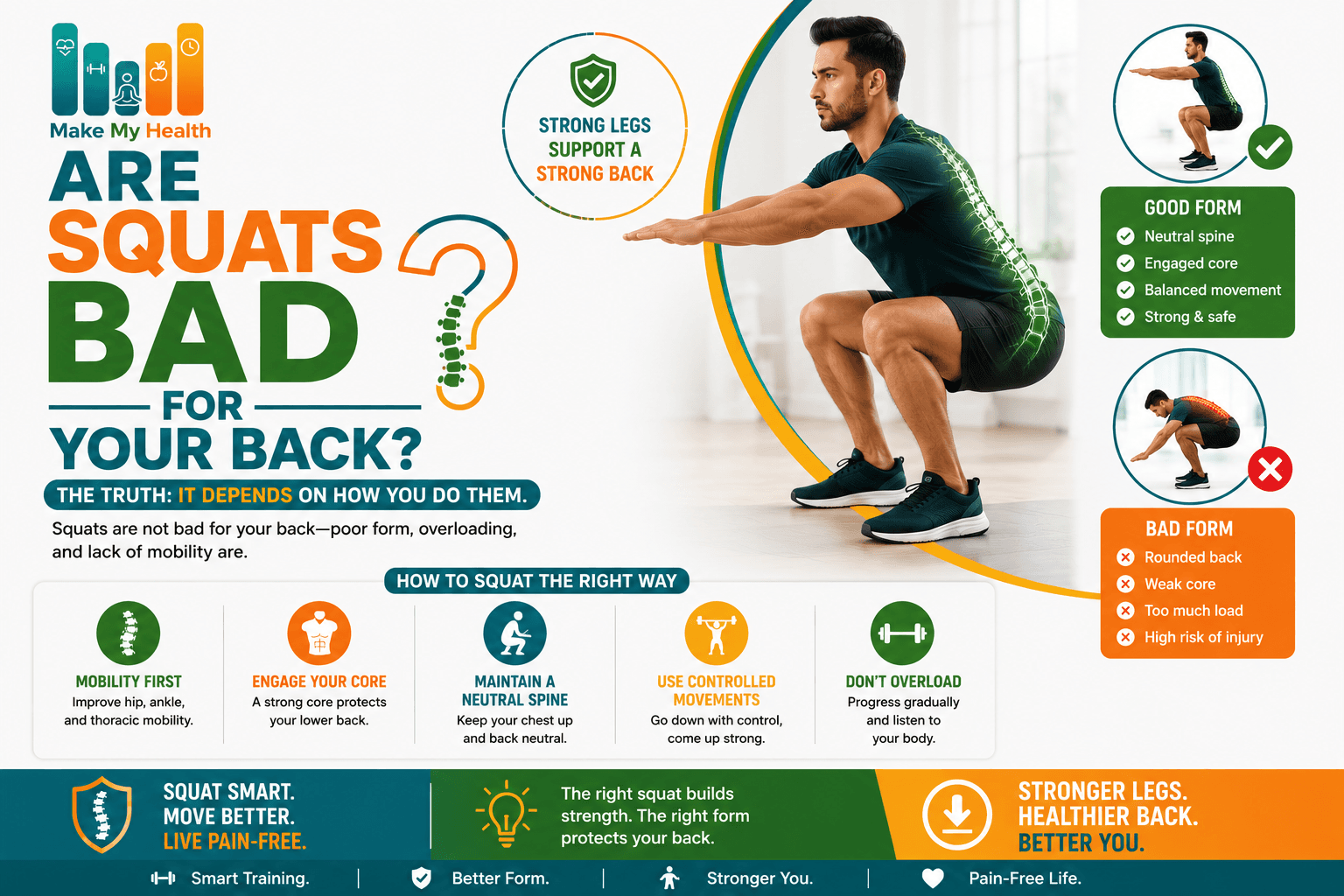
Are Squats Bad for Your Back?
DisclaimerThis article is for general educational purposes and is not a substitute for professional medical advice, diagnosis, or treatment. Always consult a qualified healthcare provider for guidance specific to your condition.
Are squats really the villain behind back pain or is the truth hidden in how you perform them?
Introduction
Let’s face it, squats have a legendary status in the fitness world. They’re championed for building jaw-dropping leg strength and unleashing explosive athletic power. But, lurking in every gym and online forum is a nagging fear: Are squats actually dangerous for your back?
You’ve probably heard horror stories of crushed discs, chronic agony, and the ominous warning, “Squats will wreck your spine!” But are these claims justified, or are they just the result of misinformation, poor technique, or isolated mishaps? Let’s untangle the facts from fearmongering and reveal the truth behind squats and back health, with real numbers, science, and practical advice.
1. The Anatomy of a Squat
Before we dive into the controversy, let’s break down what a squat actually is. At its core, the squat is a powerful compound movement, which means it fires up a whole team of muscles and joints in one fell swoop.
Main Muscles at Work:
- Quadriceps (front thighs)
- Gluteus Maximus (your glutes!)
- Hamstrings (back of thighs)
- Erector Spinae (your lower back’s bodyguards)
- Core stabilizers (transverse abdominis and obliques)
- Calves
While your quads and glutes do most of the heavy lifting, your erector spinae and core muscles are the unsung heroes, fighting to keep your spine safe and stable. Mess up your back alignment? That’s when trouble (and pain) can strike.
Primary Muscle Activation During Squats
| Muscle Group | Activation Level (%) | Main Function During Squat |
|---|---|---|
| Quadriceps | 60–80% | Knee extension |
| Gluteus Maximus | 50–70% | Hip extension |
| Hamstrings | 20–40% | Hip extension, knee stabilization |
| Erector Spinae | 30–50% | Spinal stabilization |
| Core Stabilizers | 25–45% | Trunk support, intra-abdominal pressure |
Hot tip: Your erector spinae can hit a whopping 50% activation during heavy squats. That’s why your form is absolutely critical for back safety.
2. Common Concerns: Why Do People Say Squats are Bad for Your Back?
So, why do squats get dragged through the mud? Let’s unpack the most common (and dramatic) concerns:
a. Fear of Spinal Compression
The word “compression” alone sends chills down some people’s spines. Stack 100 kilograms (220 lbs) on your back, and the image of your discs getting crushed can be hard to shake. According to a 2017 study, spinal compression during a heavy squat can hit 6,000 Newtons—that’s like having 600 kilograms pressing on your lower back! Terrifying, right?
But here’s the twist: The human spine is an engineering marvel, designed to withstand massive loads if your technique is spot-on.
b. Association with Lower Back Pain
Plenty of lifters complain about back pain after squats. But is the squat really the villain, or are factors like poor mobility, bad form, or pre-existing injuries the real culprits? In a survey of 1,200 gym-goers, 28% said they avoid squats due to back pain. Yet, over 70% of those folks admitted they’d never been taught proper squat technique. Coincidence? Unlikely.
c. Misconceptions and Misinformation
Thanks to the internet, squatting nightmares spread like wildfire, often missing crucial context. Was the load too heavy? Was the technique sloppy? Was the lifter prepared? Without these details, myths take root and thrive.
3. The Science: What Research Really Says
Let’s cut through the drama and look at what the evidence actually shows:
a. Studies on Injury Rates
Check this out: A sweeping review in the Journal of Strength and Conditioning Research (2018) found that squats have an injury rate of just 2.7 per 1,000 training hours. That’s way lower than running (7.7/1,000 hours) and a far cry from contact sports like American football (12.1/1,000 hours). Of all squat injuries, only 24% involved the lower back. Surprised?
b. Benefits Outweigh Risks (with Good Form)
The research is clear: When you squat with proper technique, you’re not dooming your back. In fact, squats can actually strengthen your lower back. A 12-week study on older adults (average age: 58) found a 22% increase in lumbar extensor strength from supervised squatting, with zero rise in back pain.
c. The Importance of Load Management
Going too heavy, too fast is a recipe for disaster. The National Strength and Conditioning Association (NSCA) recommends ramping up your weight by just 2.5–5% per week to keep injuries at bay.
4. Factors That Make Squats Risky for the Back
Not all squats are created equal, and some mistakes can turn this heroic move into a back-wrecking nightmare.
a. Poor Technique
Rounding your lower back or leaning too far forward can skyrocket spinal shear forces. If your bar path is off or your chest collapses, you could be shifting over 30% more stress onto your lower back. Ouch!
b. Inadequate Mobility
Stiff ankles or hips can sabotage your squat depth and form, leading to ugly compensations like butt wink or knee cave. A 2020 study found that poor ankle mobility made lifters 2.3 times more likely to feel back pain during squats.
c. Fatigue and Overtraining
When you’re wiped out, your muscles can’t stabilize your spine, making form breakdown and injury a real threat. Overtraining (more than 3 heavy squat sessions per week) spiked injury rates by 40% in college athletes.
d. Pre-existing Back Issues
If you’ve got a history of herniated discs or chronic back pain, you’re at higher risk. In fact, a 2019 meta-analysis showed prior lumbar injuries nearly doubled (1.8x) your chances of pain during loaded squats.
5. Proper Squat Technique: Step-by-Step
Ready to unleash the true power of squats safely? Here’s your step-by-step guide to bulletproof form:
Step 1: Set Up
- Bar Placement: Rest the bar evenly across your upper traps (high-bar) or rear delts (low-bar).
- Foot Position: Feet shoulder-width apart, toes out 15–30 degrees.
- Brace Core: Take a big breath and tighten your abs for maximum spinal armor.
Step 2: Descent
- Hinge Hips: Push hips back and bend at the knees.
- Neutral Spine: Keep your chest proud, back flat, and eyes ahead.
- Control: Lower yourself slowly, aiming for thighs parallel to the floor or a bit deeper.
Step 3: Bottom Position
- Knees Over Toes: Don’t let knees collapse in or shoot too far forward.
- Weight Distribution: Stay balanced over your mid-foot.
Step 4: Ascent
- Drive Up: Push through your heels and mid-foot, extending hips and knees.
- Core Engagement: Keep your abs tight and spine neutral as you rise.
- Lockout: Stand tall, no need to hyperextend your back.
Common Technique Errors and Corrections
| Error | Back Risk Level | Correction |
|---|---|---|
| Rounding lower back | High | Strengthen core, reduce depth |
| Excessive forward lean | Moderate | Adjust bar position, improve mobility |
| Knee collapse inward | Moderate | Strengthen glutes, use cues |
| Heels lift off floor | High | Improve ankle mobility, cue heels down |
6. Variations: Are Some Squats Safer Than Others?
There’s more than one way to squat! Each version hits your back a little differently.
a. Front Squats vs. Back Squats
Front squats (barbell on the shoulders) pull your center of gravity forward, forcing your core to work overtime but actually reducing lower back stress by 16–20% compared to back squats at the same weight.
b. Goblet Squats
Holding a dumbbell or kettlebell at your chest encourages a more upright posture, less weight, less risk, and a fantastic option for beginners.
c. Box Squats
Sitting back onto a box or bench teaches you proper mechanics and can slash spinal loading by up to 18%. Talk about a back-saver!
Comparison of Squat Variations and Back Stress
| Squat Variation | Back Load (Relative) | Best For |
|---|---|---|
| High-Bar Back | Moderate–High | Strength/athletes |
| Low-Bar Back | High | Powerlifting |
| Front Squat | Lower | Core, Olympic lifts |
| Goblet Squat | Low | Beginners, rehab |
| Box Squat | Low–Moderate | Teaching form, rehab |
7. Who Should Be Cautious with Squats?
For some people, squats require a little extra caution or a professional’s touch.
a. Individuals with Acute Back Injuries
If you’re dealing with a fresh spinal injury or sharp back pain, stop and get your doctor’s green light before squatting. Even bodyweight squats can backfire if you’re not careful.
b. Older Adults or Those with Osteoporosis
As we age, bone density drops. For folks over 60 (especially women with osteoporosis), heavy squats can be risky. Stick with lighter weights, higher reps (15–20), and always focus on perfect form.
c. Novices and Youth Athletes
Beginners are more likely to make rookie mistakes. Start with professional guidance and keep the load light (as low as 20% of your body weight).
d. Pregnant Women
Pregnancy throws off balance and loosens joints. Modify your squats, go shallower, use support, and listen to your body.
Populations Needing Extra Precaution
| Group | Main Concern | Recommended Modifications |
|---|---|---|
| Acute back injury | Re-injury risk | Medical clearance, rehab focus |
| Osteoporosis | Fracture risk | Light loads, higher reps |
| Beginners/youth | Form errors | Professional instruction |
| Pregnancy | Joint laxity, balance | Reduced depth, use support |
8. Practical Tips to Squat Safely
Ready to squat like a pro and keep your back bulletproof? Here’s how:
- Warm Up Thoroughly: Spend 5–10 minutes unlocking tight hips, ankles, and upper back.
- Perfect Your Form: Technique comes first. Get a coach for your first 4–6 weeks if you can.
- Use Appropriate Load: Start light and bump up the weight by no more than 2.5–5% each week.
- Listen to Your Body: Sharp back pain is a massive red flag. Don’t push through it.
- Strengthen Support Muscles: Add planks, glute bridges, and hamstring work to your routine.
- Try Variations: If back squats hurt, experiment with goblet or front squats.
- Monitor Frequency: For most, 2–3 squat sessions per week is plenty.
- Rest and Recover: Give yourself at least 48 hours between heavy sessions.
9. When to Seek Professional Help
Look, even the best self-coached lifters can miss subtle mistakes. If your back pain won’t quit, your form feels “off,” or you’re just not sure you’re doing it right, seek help from a physical therapist, certified strength coach, or sports medicine pro. Sometimes a fresh set of expert eyes is all it takes to turn agony into victory.
Final Thoughts
Squats aren’t the back-breaking monsters they’re sometimes made out to be. With smart technique, gradual progress, and a little expert help when needed, squats can be a sensational tool for building strength and resilience. So, don’t let fear or misinformation hold you back, embrace the squat (safely!), and let your lower body and back reap the rewards.
For personalized advice, consult a qualified fitness or healthcare professional. This blog is for informational purposes only and does not substitute for medical guidance.
Now go forth and squat fearlessly, wisely, and with confidence!
Conclusion:
Squats, when executed with proper technique and appropriate loading, are not inherently bad for your back. In fact, research shows they can enhance lower back strength and overall athletic performance. The key risks arise from poor form, inadequate mobility, or overtraining, not from the movement itself. By understanding biomechanics, choosing the right squat variation, and paying attention to individual limitations, most people can safely include squats in their routine. Ultimately, informed practice and attention to your body’s signals are essential for reaping the benefits of squats without compromising back health.
FAQ:
-
Are squats safe for people with previous back injuries?
People with a history of back injuries should consult a healthcare provider before performing squats and may require specific modifications or alternative exercises. -
Which squat variation is safest for the back?
Variations like goblet squats and front squats generally place less stress on the lower back and are good options for beginners or those with back concerns. -
How can I reduce the risk of back injury during squats?
Focus on perfecting technique, start with lighter weights, consider professional coaching, and listen to your body to avoid pain or discomfort.
Stay updated
Get new health articles on WhatsApp
By subscribing, you agree to receive health updates via WhatsApp. Unsubscribe anytime.