
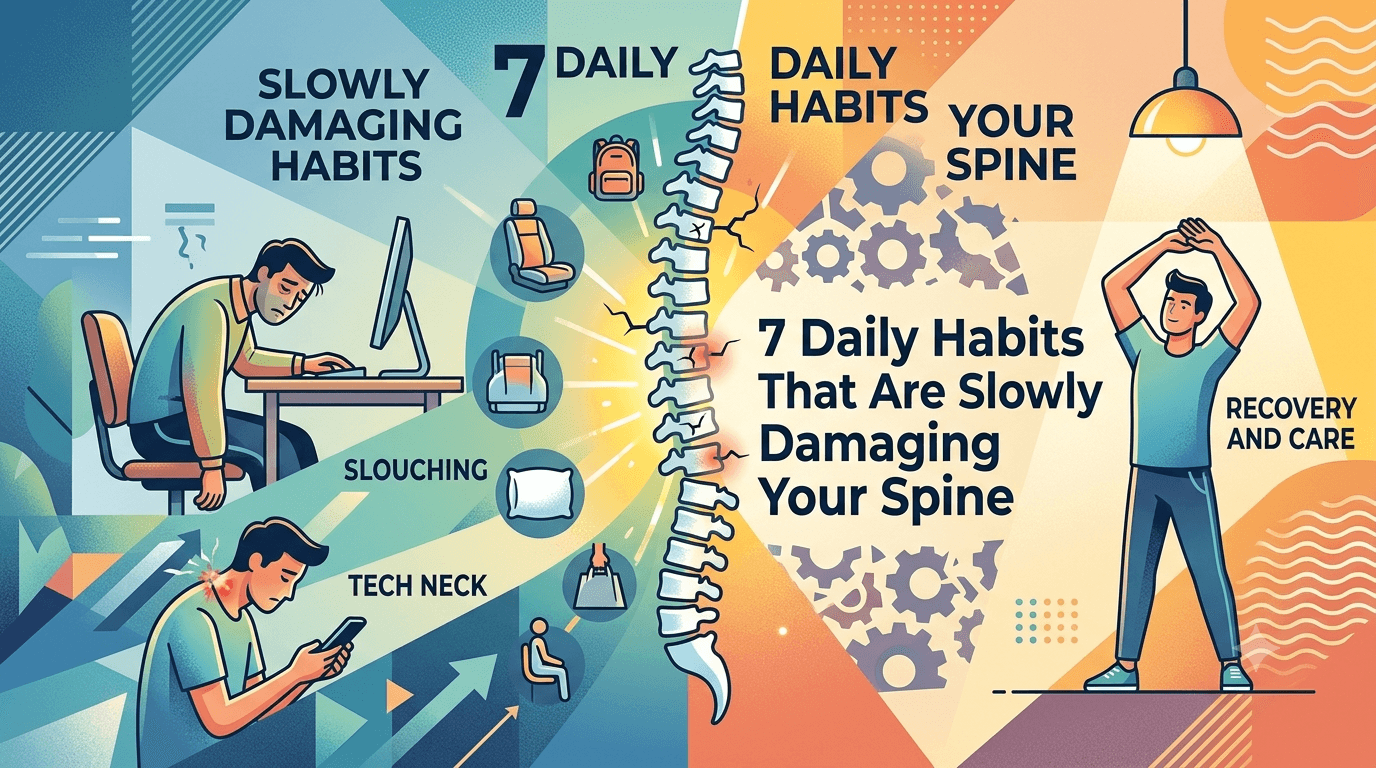
7 Daily Habits That Are Slowly Damaging Your Spine
- Can Poor Posture Cause Permanent Spine Damage?
- 6 Effects of Poor Posture on the Body | Integrated Rehabilitation
- Poor Posture & its Effects on the Body
- 10 Daily Habits Damaging Your Spine | Spine Specialist in Mumbai
- The Health Effects of Poor Posture
- Association between sitting and occupational LBP - PMC
- Lower Back Pain When Sitting: Causes, Stretches, and Treatment
- 5 Common Mistakes That Could Lead to Back Pain - Mainstay Medical
DisclaimerThis article is for general educational purposes and is not a substitute for professional medical advice, diagnosis, or treatment. Always consult a qualified healthcare provider for guidance specific to your condition.
Are your daily habits secretly sabotaging your spine, turning minor aches into lifelong pain?
Let’s face it: most of us don’t give our spines much thought until agony strikes. But did you know some everyday habits could be secretly sabotaging your back health, setting the stage for a nightmare of discomfort, reduced mobility, or even chronic pain? The good news: a little awareness can work wonders. Let’s dive into the spine-chilling habits you might be doing right now and how to break free before it’s too late.
1. Poor Posture While Sitting
Be honest, how many hours do you spend sitting each day? If you’re like the average office worker, it’s a mind-blowing 10 hours. But here’s where things get dangerous: slouching or hunching your shoulders piles excessive strain on your spine, especially the lower back (lumbar region). Your spine’s natural curve is supposed to absorb shock and distribute weight, but when you collapse that curve by sitting with a rounded back, disc pressure skyrockets by up to 40%. Over time, this relentless assault leads to muscle fatigue, disc degeneration, and even devastating chronic pain.
How Poor Sitting Posture Wreaks Havoc
- Shoulders roll forward, yanking the upper spine out of alignment.
- Lower back rounds are losing vital lumbar support.
- Disc pressure soars by as much as 40%.
- Muscles fatigue, triggering tension and discomfort.
- Over time, chronic back pain sets in like an uninvited guest.
Table: The Spine’s Reaction to How You Sit
| Sitting Position | Disc Pressure Increase | Risk of Chronic Pain |
|---|---|---|
| Upright (ergonomic) | +10% | Low |
| Slouched/Hunched | +40% | High |
| Reclined (unsupported) | +25% | Moderate |
Is it any wonder that back specialists are seeing an avalanche of patients suffering from posture-related agony?
2. Neglecting Regular Physical Activity
Physical inactivity is the spine’s silent enemy, especially in our screen-obsessed, urban lifestyle. Your spine craves movement to keep discs nourished and muscles strong. Skipping daily activity, even a simple walk, can be disastrous. Groundbreaking research has revealed that adults who do less than 150 minutes of moderate exercise per week face a 33% higher risk of lower back pain than their more active friends.
The Domino Effect of Inactivity
- Muscle Weakness: When you skip movement, the muscles that stabilize your spine wither, leaving it dangerously unsupported.
- Disc Dehydration: Activity pumps nutrients into your discs. Without it, they dry out, becoming brittle and vulnerable.
- Stiff Joints: Lack of motion leaves your joints stiff and unyielding, especially first thing in the morning.
Step-by-Step: How Inactivity Assaults Your Spine
- Spinal support muscles weaken.
- Discs lose nutrition and get brittle.
- Joints stiffen—flexibility plummets.
- Spinal function declines—sometimes for good.
According to leading orthopedic studies, people who stick to regular exercise are 45% less likely to face spine-related mobility nightmares after age 60. That’s a victory worth fighting for!
3. Improper Lifting Techniques
Ever bent over at the waist to pick up a box? You’re not alone—and that simple move can unleash a catastrophe for your back. Lifting incorrectly can jack up the strain on your lower spine by a jaw-dropping 300%. If you don’t bend your knees and keep your legs straight, your lumbar spine absorbs a punishing blow, raising the odds of herniated discs, muscle tears, and more.
Table: How Lifting Methods Put Your Spine at Risk
| Technique | Estimated Strain (%) | Injury Risk |
|---|---|---|
| Bent knees, straight back | +30% | Low |
| Bending at waist | +300% | High |
| Twisting while lifting | +250% | Very High |
Step-by-Step: Lifting Safely and Powerfully
- Stand close to the object—don’t reach.
- Bend your knees (not your waist).
- Keep your back straight—like a steel beam.
- Lift with your legs—let them do the heavy work.
- Avoid twisting—pivot with your feet instead.
Just one careless lift—especially with anything over 20 kg—can trigger a devastating spinal injury that might haunt you for months.
4. Excessive Smartphone Use (Text Neck)
Smartphones are addictive, indispensable, and they’re quietly wreaking havoc on your neck and spine. “Text neck” is more than just a trendy phrase; it’s an epidemic. Every time you tilt your head 60 degrees to check a message, you’re cranking up the effective weight on your cervical spine from 5 kg to a staggering 27 kg. That’s a fivefold increase! Spend hours in this position, and you’re inviting muscle strain, disc injuries, and even early wear-and-tear on your neck vertebrae.
Table: Neck Angle and the Crushing Weight on Your Spine
| Neck Angle (degrees) | Effective Weight on Spine (kg) |
|---|---|
| 0 (upright) | 5 |
| 15 | 12 |
| 30 | 18 |
| 45 | 22 |
| 60 | 27 |
How “Text Neck” Creeps Up on You
- Head tilts to see the screen.
- The cervical spine absorbs brutal extra weight.
- Muscles fatigue and tighten.
- Discs compress dangerously.
- Chronic neck pain becomes your new normal.
Spine clinics now report that over 60% of young adults are trapped in this cycle of pain directly linked to smartphone use. It’s a modern-day plague you don’t want to catch!
5. Sleeping on Unsupportive Mattresses or Pillows
Sleep is supposed to be blissful and restorative for your spine, but only if your mattress and pillow have your back (literally!). Here’s a shocking fact: mattresses older than 8 years lose up to 70% of their original firmness, leaving your spine misaligned all night long. And if your pillow is too high or too flat? Say hello to neck stiffness and pounding headaches.
Table: Mattress Age—How It Betrays Your Spine
| Mattress Age (years) | Support Level | Risk of Pain |
|---|---|---|
| 0–2 | Excellent | Low |
| 3–8 | Moderate | Moderate |
| 9+ | Poor | High |
The Hidden Dangers of Poor Sleep Support
- Mattress sags—spine loses crucial support.
- Pillow messes with your neck alignment.
- Muscles tense up overnight.
- You wake up stiff or in pain every single day.
Want to conquer sleep-related spine issues? Replace your mattress every 8 years and choose an ergonomic pillow. Studies show this can slash sleep-related back problems by a stunning 30%.
6. Wearing High Heels or Unsupportive Footwear
Fashion can be seductive, but it’s not always spine-friendly. High heels (over 5 cm) dramatically shift your body’s center of gravity, forcing your lower back into an unnatural, painful arch. Even flat sandals without arch support can trigger poor posture and a domino effect of spinal misalignment that’s hard to reverse.
Table: How Your Shoes Can Torture Your Spine
| Footwear Type | Lumbar Stress Increase (%) | Posture Risk |
|---|---|---|
| Flats (arch support) | +5% | Low |
| Flats (no support) | +20% | Moderate |
| High heels (>5 cm) | +60% | High |
How Footwear Becomes a Back Pain Trap
- Heels lift your feet, pelvis tilts forward.
- Lower back arches excessively.
- Vertebral joints get crushed.
- Muscles tire out.
- Posture starts to fall apart.
Podiatrists estimate that a jaw-dropping 80% of chronic lower back pain in women is linked to their choice of shoes. Talk about a hidden trap!
7. Ignoring Early Signs of Back Pain
Pain is your body’s urgent warning signal. Ignore it at your peril. Nearly 80% of adults will be haunted by back pain at some point, but most brush off early symptoms as “just a twinge.” That’s a risky move: neglecting minor pain can quickly snowball into chronic conditions like sciatica, disc herniation, or even irreversible nerve damage.
How Ignoring Back Pain Can Spiral Out of Control
- Minor pain signals early trouble.
- Without action, damage intensifies.
- Chronic inflammation takes hold, it’s not going away on its own.
- Mobility shrinks, and everyday activities become a struggle.
- Permanent damage becomes a terrifying reality.
Table: The Shocking Cost of Ignoring vs. Acting on Back Pain
| Response to Pain | Recovery Time | Risk of Chronic Issues |
|---|---|---|
| Early intervention | 2–4 weeks | Low |
| Ignored symptoms | 6–12 months | High |
Pain specialists warn: timely treatment can slash your risk of chronic back trouble by a whopping 70%. Don’t wait, listen to your body!
Final Thoughts: Your Spine Deserves Better
Your spine is nothing short of miraculous, a sensational structure that lets you stand tall, move freely, and chase your dreams. But it’s also vulnerable, and these sneaky daily habits can unleash a cascade of pain and suffering if left unchecked.
Ready for a mind-blowing transformation?
Start by making small tweaks today:
- Sit tall and proud, ditch the slouch.
- Move your body every step is a victory.
- Lift smart, your back will thank you.
- Give your phone a break, your neck needs it.
- Sleep like royalty with a mattress and pillow that support you.
- Choose shoes that love your spine.
- And never, ever ignore pain, your future self will be grateful.
Your spine is your backbone, literally and figuratively. Treat it with the respect it deserves, and it’ll carry you through a lifetime of triumphs.
Conclusion:
Protecting your spine health is not just about avoiding obvious injuries, it's about being mindful of everyday habits that can quietly cause significant long-term damage. From poor posture and physical inactivity to improper lifting, excessive smartphone use, unsupportive sleep, and neglecting early warning signs, each plays a critical role in spinal well-being. By understanding and addressing these common mistakes, you can reduce your risk of chronic pain and maintain a strong, resilient back throughout life. Take action now, your spine will thank you for years to come.
FAQ:
-
How can I improve my sitting posture to protect my spine?
Sit with your feet flat on the floor, back straight, and shoulders relaxed. Use an ergonomic chair if possible, and take regular breaks to stand and stretch. -
What type of physical activity is best for spinal health?
Low-impact activities like walking, swimming, yoga, and core-strengthening exercises help support spinal muscles and maintain flexibility. -
When should I seek medical advice for back pain?
If back pain persists for more than a few days, worsens, or is accompanied by numbness, tingling, or weakness, consult a healthcare professional promptly.
Stay updated
Get new health articles on WhatsApp
By subscribing, you agree to receive health updates via WhatsApp. Unsubscribe anytime.